


 The History of JCB: From a Wartime Garage to a Global Construction Giant
Walk past any building site in the world and chances are you will spot a big yellow machine getting to work. You might not know its exact model, but you almost certainly call it a JCB. That name has become so embedded in everyday language that people use it the way they use 'Google' or 'Hoover'. But where did it all begin?
The history of JCB is one of the most fascinating origin stories in British manufacturing. It starts with one determined man, a handful of war surplus parts, and a small rented garage in Staffordshire. What came next would change the construction industry forever.
What is JCB?
JCB stands for Joseph Cyril Bamford, the full name of the company's founder. The official company name is JCB Excavators Ltd, but most people simply say JCB when referring to any kind of digger, backhoe loader, or excavator, regardless of brand.
JCB as a company produces a wide range of heavy machinery including backhoe loaders, telescopic handlers, excavators, wheel loaders, compactors, and electric machines. But the backhoe loader is the product that made the name famous worldwide.
Curious about JCB's full product range? Click here to explore their machines.
The Man Behind the Brand: Who Founded JCB?
Joseph Cyril Bamford was born in 1916 into a family with a background in engineering. He was entrepreneurial from an early age and had a restless, problem-solving mind. His personal motto was 'Jamais content', a French phrase meaning 'never satisfied'. That spirit of always wanting to do better drove everything he built.
After World War II, Bamford rented a small garage in Uttoxeter, Staffordshire, for 30 shillings a week. He had very little money but a lot of ideas. Using leftover war surplus materials and scrap metal, he got to work building something useful.
What he created would become one of the most recognised brands in British industrial history.
History of JCB: How It All Started in 1945
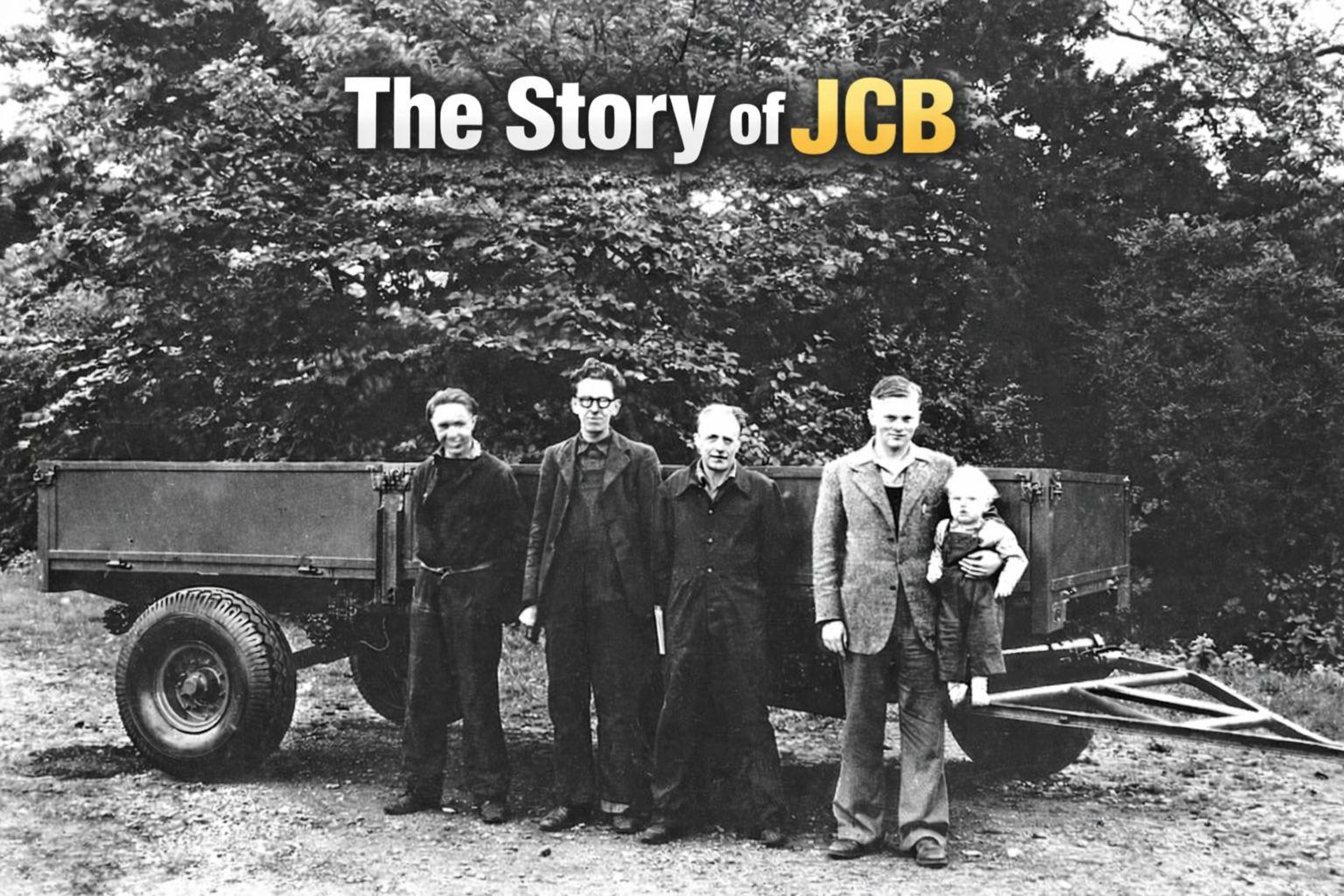
In 1945, Joseph Cyril Bamford built his first product: a simple all-steel tipping trailer. It was made using wheels and tyres from a Grumman Hellcat fighter aircraft and hubs salvaged from a small howitzer. Not glamorous, but practical. He sold it at a local market for 45 pounds.
From that first sale, the business began to grow. Just four years later, in 1949, Bamford launched Europe's first industrial front-end loader, known as the Major Loader. It was a big step forward and set the tone for the innovation that would come to define JCB.
Then in 1953 came the moment that changed everything. Bamford attached a prototype excavator with hydraulic rams to the back of a front-loader and invented the world's first backhoe loader, the MK 1 Excavator. It was a revolutionary idea that brought hydraulic power to construction sites and shaped the whole industry's future.
Key Milestones in JCB's Innovation Timeline
The history of JCB is packed with firsts. Here are the milestones that shaped the brand decade by decade.
1960s and 1970s: Building a Legacy
In 1963, the iconic JCB 3C backhoe loader was launched and quickly became acknowledged as a design classic. By 1964, JCB had produced its first crawler excavator, the JCB 7. Then in 1977, the JCB 520 telescopic handler arrived. It was born from blue-sky thinking and became so successful that the modern Loadall range still carries that same pioneering DNA today.
1980s: A Bestseller is Born
1985 was a landmark year. JCB celebrated the production of its 100,000th backhoe and launched the 3CX Sitemaster, which went on to become the company's best-selling backhoe loader of all time. It remains a familiar sight on construction sites across the world to this day.
1990s: Reinventing the Tractor
JCB has never been afraid to disrupt its own industry. In 1991 the company launched the Fastrac, the world's first high-speed tractor with full suspension. It broke with over 40 years of traditional tractor design and gave farmers something completely new.
2000s to 2010s: Scale and Sustainability
By 2004, JCB had produced 500,000 machines in total. Ten years later the count reached one million. In 2018, JCB launched its first all-electric mini excavator, the 19C-1E, capable of running a full working day on a single charge. By 2022, they had already built 1,000 of them.
2020s: The Hydrogen Era
In 2020, JCB developed the construction industry's first hydrogen-powered excavator. By 2021, the company had invested 100 million pounds into hydrogen engine development. In 2025, hydrogen-powered JCB machinery was given the green light to drive on UK public highways, a historic moment for clean energy in construction.
Why Do People Call Every Digger a JCB?
This is something not many brand history articles explain, and it is actually quite remarkable. JCB became so dominant in the UK construction market during the 1950s and 60s that the brand name became the generic word for the machines themselves. Much like 'Hoover' became the word for vacuum cleaners, 'JCB' became the shorthand for diggers.
It did not happen by accident. JCB machines were everywhere. They were reliable, highly visible in their bright yellow livery, and sold at scale before any serious competition arrived. The yellow colour and the distinctive shape became a cultural fixture. Today, children grow up calling any digger a JCB, even if it is made by a completely different manufacturer.
For the brand, this is the ultimate marketing achievement. JCB did not just build products. It built a language.
JCB Goes Green: The Electric and Hydrogen Revolution
JCB could have coasted on its success in diesel-powered machinery. Instead, it invested billions into cleaner alternatives.
The electric journey started in 2018 with the JCB 19C-1E mini excavator, designed for indoor work, urban environments, and zero-emission job sites. The range has expanded significantly since then, with electric wheel loaders, articulated booms, and more.
The hydrogen story is arguably even more exciting. JCB's hydrogen combustion engine, which runs on hydrogen fuel rather than diesel, won the prestigious Royal Automotive Club Dewar Trophy in 2021. In 2024, JCB produced its one millionth engine, with hydrogen technology playing a growing role in its future plans.
The brand is betting on a future where construction sites produce far less noise, far fewer emissions, and lower running costs for operators. That ambition is very much in line with the 'Jamais content' philosophy of its founder.
JCB's Global Journey: Which Country Does JCB Belong To?
JCB is a British company, founded in England and still headquartered in Rocester, Staffordshire. It is privately owned by the Bamford family and remains one of the UK's most successful privately held manufacturers.
But JCB's reach is genuinely global. The company operates 22 plants across four continents and has over 750 dealers worldwide. India is one of JCB's largest and most important markets. The company entered India in the late 1970s and has built strong manufacturing operations there, with models like the JCB 3DX Backhoe Loader designed specifically for the Indian market and exported globally.
In 2024, JCB broke ground on a new 500 million dollar factory in San Antonio, Texas, its largest single investment ever. The 720,000 square foot facility will create 1,500 jobs over five years and focus on Loadall telescopic handlers and aerial access equipment for the North American market.
Fun Facts You Probably Did Not Know About JCB
JCB has a few stories that do not always make it into the history books, but they are worth knowing.
• The JCB GT, launched in 1988, was a modified backhoe loader powered by a Chevrolet V8 engine. It could reach 160 kilometres per hour and wowed crowds at the British Grand Prix.
• In 2019, JCB built the world's fastest tractor. The JCB Fastrac Two hit a verified top speed of 153.771 mph at Elvington Airfield, driven by Guy Martin and built by a team of young JCB engineers.
• JCB's one millionth backhoe loader was produced in 2025, a journey that began with the very first prototype in 1953.
• King Charles III visited JCB's World Headquarters in 2025 to mark the company's 80th anniversary and the production of that millionth backhoe.
• JCB started making its own engines in 2004. By 2024, the company had produced its one millionth engine, growing from three a day to nearly 300 at peak production.
FAQs About JCB
What does JCB stand for?
JCB stands for Joseph Cyril Bamford, the full name of the company's founder who started the business in Uttoxeter, England in 1945.
Who invented the JCB backhoe loader?
Joseph Cyril Bamford invented the world's first backhoe loader in 1953 by combining a front loader with a hydraulic rear excavator. It was called the MK 1 Excavator and it changed construction forever.
Which country is JCB from?
JCB is a British company, founded and headquartered in Staffordshire, England. It is still privately owned by the Bamford family. While it manufactures globally, including in India, the USA, and Brazil, the UK remains its home base.
Is JCB still a family-owned company?
Yes. JCB is one of the largest privately owned manufacturing companies in the UK. Lord Bamford, son of founder Joseph Cyril Bamford, chairs the company. It has never been publicly listed on a stock exchange.
What is the most popular JCB model?
The JCB 3CX backhoe loader is the company's best-selling machine of all time and one of the most recognisable pieces of construction equipment in the world. In India, the 3DX variant is particularly popular.