


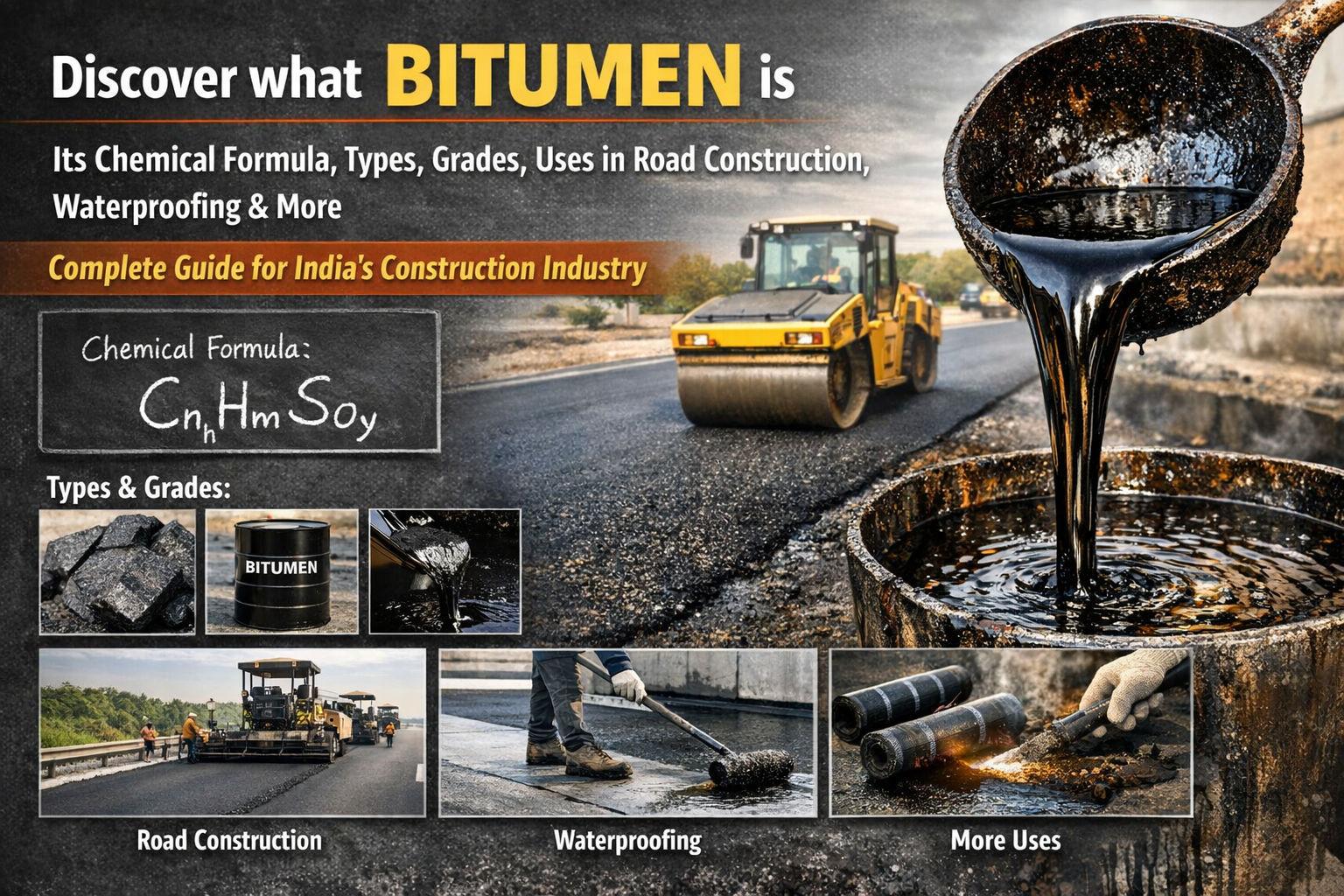
 If you work in construction, road laying, or infrastructure, you have definitely come across bitumen. It is the backbone of almost every road you drive on and most waterproofing systems in modern buildings. But what exactly is bitumen, and why does its grade matter so much?
This guide covers everything from the basic bitumen meaning to bitumen chemical formula, grades, tests, applications in India, and the best products available. Whether you are sourcing material for highway projects or pothole repairs, this is the resource you need.
What Is Bitumen?
Bitumen is a dark, viscous, petroleum-based substance produced during the distillation of crude oil. It is sticky, highly durable, and completely resistant to water, which makes it the go-to binding agent in road construction and waterproofing systems worldwide.
Think of bitumen as the glue that holds asphalt together. Without it, the aggregates, gravel, and sand used in road construction would simply fall apart under traffic loads.
Bitumen meaning in simple terms: a refined petroleum residue that acts as a binder and sealant across construction applications.
Bitumen chemical formula: Bitumen does not have a single fixed chemical formula. It is a complex mixture of organic hydrocarbons, mostly made up of carbon (85%), hydrogen (10%), sulfur (0-9%), oxygen (0-2%), and nitrogen (0-2%), along with trace metals like vanadium, iron, and nickel.
It is also found naturally in oil sands, primarily in Canada, Venezuela, and parts of the Middle East. Natural bitumen, known as Gilsonite, has been used for centuries.
Bitumen vs Asphalt vs Tar: What Is the Difference?
These three terms are often used interchangeably, but they are not the same thing.
• Bitumen: The raw petroleum-based binder. It is the key ingredient in asphalt.
• Asphalt: A mixture of bitumen and aggregates like gravel and sand, used to surface roads.
• Tar: Derived from coal or wood distillation, not crude oil. It is high in benzene and mostly phased out due to health risks.
In India and most of the world, when someone talks about a bitumen road, they mean a road whose surface layer is made with an asphalt mix where bitumen acts as the binder.
What Is Bitumen Used For?
Bitumen is one of the most versatile construction materials available. Its uses span far beyond roads and highways.
Road Construction
Over 85% of global bitumen production goes into road construction. When you see bitumen pouring on a road during highway work, that is penetration grade or viscosity grade bitumen being laid as part of the asphalt mix. It binds all the aggregates together and creates a smooth, load-bearing surface.
Click here to checkout Asphalt Drum Mix Plants on MachanX.
Bitumen Waterproofing
Bitumen waterproofing is widely used in buildings, basements, roofs, bridges, and dams. Bitumen paint and bitumen sheets form an impermeable membrane that prevents water from seeping through concrete structures. It is especially popular in monsoon-heavy regions across India.
Roofing
Modified bitumen roofing sheets are a standard product in commercial construction. They provide excellent UV resistance, flexibility, and watertight sealing for flat roofs.
Industrial Applications
Bitumen is used to coat underground pipelines and cables, preventing corrosion and moisture damage. It is also used as a soundproofing compound in automotive underbody coatings.
Airport Runways
Polymer Modified Bitumen (PMB) is the standard for airport runways because it handles extreme loads and temperature variation far better than standard bitumen grades.
What Are the Primary Uses of Bitumen in Construction Projects?
For construction professionals, bitumen plays these key roles:
• Binding agent in hot mix asphalt (HMA) for roads and highways
• Tack coat between asphalt layers to ensure bonding — applied uniformly using a Bitumen Sprayer , which gives precise, consistent coverage across the road surface.
• Prime coat applied directly on prepared sub-bases before laying asphalt — a Bitumen Sprayer ensures the right emulsion rate for proper penetration into the base layer.
• Waterproofing membranes for roofs, basements, and retaining walls
• Chip seal and slurry seal for road maintenance and surface dressing
• Expansion joint filler in concrete pavements
• Corrosion protection for buried pipelines and structures
Each of these applications uses a specific type and grade of bitumen, which is why understanding the different grades matters so much during procurement.
Grade of Bitumen: Types and Classification
Bitumen is classified into several grades based on its production process and performance characteristics. Here is a breakdown of the most common types used in India.
1. Penetration Grade Bitumen
This is the most widely used type for road construction globally. The grade of bitumen here is measured by how deep a standard needle penetrates the sample under a fixed load at 25 degrees Celsius.
Lower penetration = harder bitumen, suited for hot climates. Higher penetration = softer bitumen, suited for cold climates.
| Grade | Penetration Range | Best Application |
|---|---|---|
| 30/40 | 30-40 | Tropical regions, very high temperatures |
| 60/70 | 60-70 | Mild climates, general road construction in India |
| 80/100 | 80-100 | Cold regions, waterproofing |
| 100/120 | 100-120 | Very cold climates, road repairs |
2. Viscosity Grade (VG) Bitumen
Viscosity grade bitumen has largely replaced penetration grade in India as per IS 73:2013. It is tested at 60 degrees Celsius and 135 degrees Celsius to better reflect real-world road temperatures.
• VG-10: Cold climate roads, bitumen emulsion production
• VG-20: Moderate traffic roads in cold regions
• VG-30: High traffic highways in India (most commonly used)
• VG-40: Heavy duty roads, extremely hot zones
3. Bitumen Emulsion
Bitumen emulsion is a liquid product where bitumen is mixed with water and an emulsifying agent. It can be applied at room temperature, making it safe and energy-efficient. It is classified as cationic (positively charged) or anionic (negatively charged).
Emulsion bitumen is commonly used for tack coats, slurry seals, chip seals, and road maintenance applications across India.
4. Cutback Bitumen
Cutback bitumen is produced by blending penetration bitumen with petroleum solvents like naphtha or diesel. It is used in cold weather applications and for priming road sub-bases. The solvent evaporates after application, leaving the bitumen binder behind.
5. Oxidized (Blown) Bitumen
Oxidized bitumen is produced by blowing hot air through bitumen at high temperatures in the refinery. This process increases its softening point and reduces its penetration, making it ideal for industrial applications like bitumen waterproofing, roofing, and pipeline coating rather than road construction.
6. Polymer Modified Bitumen (PMB)
PMB is bitumen blended with polymers like SBS (Styrene-Butadiene-Styrene) or crumb rubber. It offers superior elasticity, resistance to rutting, and fatigue cracking. This makes it the preferred choice for expressways, flyovers, and airport runways in India.
7. Performance Grade (PG) Bitumen
PG bitumen is graded based on climate performance. For example, PG 64-10 performs reliably at a maximum pavement temperature of 64 degrees Celsius and a minimum of -10 degrees Celsius. It is widely used for HMA (Hot Mix Asphalt) construction in modern road projects.
What Is Bitumen Emulsion?
Bitumen emulsion is essentially bitumen dispersed in water with the help of an emulsifier. It is a ready-to-use liquid product that does not need heating before application.
Here is why it has become so popular across Indian road and waterproofing projects:
• Applied cold, reducing energy costs and safety risks
• Environmentally friendlier compared to cutback bitumen
• Excellent adhesion to both dry and damp surfaces
• Easy to transport and store safely
Emulsion bitumen comes in three setting types: Rapid Setting (RS), Medium Setting (MS), and Slow Setting (SS), each suited to different application methods and site conditions.
For waterproofing, SS-grade emulsion bitumen is most common because it allows enough time to work before the bitumen breaks and sets.
Bitumen Test: How Is Bitumen Quality Checked?
Before any bitumen is used on site, it goes through a series of laboratory tests. These tests determine quality, classify the grade, and ensure the material will perform as expected under load and weather conditions.
Penetration Test of Bitumen
The penetration test of bitumen measures its hardness. A standard needle is applied to the bitumen surface with a 100-gram load for 5 seconds at 25 degrees Celsius. The depth of penetration in 0.1 mm units is the penetration value. High penetration means softer bitumen; low penetration means harder bitumen.
Ductility Test of Bitumen
The ductility test of bitumen measures how much the material stretches before breaking. A bitumen sample is pulled at 5 cm per minute at 27 degrees Celsius. The length at breaking point is the ductility value. Higher ductility means the bitumen can flex with road movement without cracking.
Softening Point of Bitumen
The softening point of bitumen indicates the temperature at which bitumen starts to soften and lose its load-bearing ability. Tested using the Ring and Ball method, it is a critical property for roads in hot climates like India. A higher softening point means the bitumen will resist deformation in summer heat.
Viscosity Test
Viscosity testing determines how thick or fluid the bitumen is, which affects how well it coats and bonds aggregates. Tests are done at 60 degrees Celsius and 135 degrees Celsius.
Bitumen Content Test
The bitumen content test determines the exact percentage of bitumen in an asphalt mix using solvent extraction methods. Ideal bitumen content typically ranges between 4% and 6% by weight of the total mix, depending on traffic conditions and aggregate type.
Specific Gravity and Density of Bitumen
The density of bitumen is typically between 1.01 and 1.05 g/cm3 depending on the grade. Specific gravity measurements are used to calculate bitumen volumes during mix design and quality control. Bitumen concrete density varies based on the mix design but generally falls between 2.3 and 2.5 g/cm3.
Flash and Fire Point Test
This test determines the temperature at which bitumen vapors ignite. It is critical for safe storage, transport, and handling of bitumen on site.
What Are the Common Uses of Bitumen in Road Construction in India?
India has one of the largest road networks in the world, and bitumen is at the heart of it. Here is how bitumen is specifically used in Indian road construction projects:
• VG-30 bitumen is the standard grade specified by NHAI and most state PWDs for national highways
• PMB is used on high-traffic expressways, flyovers, and bus rapid transit corridors
• Bitumen emulsion is used for rural road construction under PMGSY projects
• Cutback bitumen serves as a primer for base courses before laying asphalt
• Bitumen pouring on roads during pothole repair is done using cold mix emulsion or hot mix depending on site access
Before laying fresh bitumen on a damaged or aged road, the old deteriorated surface must be removed. This is done using a Cold Milling Machine , which precisely grinds the existing asphalt layer to a uniform depth, giving the new bitumen a clean, bonded surface to adhere to.
In road rehabilitation projects, rather than completely removing and replacing the old pavement, a Cold Recycler mills the existing bituminous surface and re-mixes it in-place with fresh bitumen emulsion. This reduces material waste significantly and cuts project costs, making it a preferred method for large highway rehabilitation contracts.
Once the hot mix asphalt is ready from the drum mix plant, it is laid uniformly across the road surface using a Paver or an Asphalt Paver. These machines control the width, thickness, and smoothness of the bitumen layer with precision, ensuring a consistent riding surface across the full project stretch.
For large-scale road projects requiring consistent and efficient hot mix production, using a proper asphalt drum mix plant is essential. These plants ensure the bitumen and aggregates are mixed at the right temperature and proportion, delivering consistent asphalt quality across the entire project.
Bitumen Price in India (2026)
Bitumen prices in India change frequently based on crude oil prices, import parity, and refinery decisions. Here are approximate market ranges as of 2026:
• VG-10: Rs 45,000 to Rs 48,000 per MT
• VG-30: Rs 48,000 to Rs 52,000 per MT
• VG-40: Rs 50,000 to Rs 55,000 per MT
• PMB: Rs 65,000 to Rs 80,000 per MT
• Bitumen Emulsion: Rs 35,000 to Rs 42,000 per MT
• Cutback Bitumen: Rs 55,000 to Rs 65,000 per MT
Prices vary based on supplier location, packaging type (drum, bulk, or jumbo bag), and order quantity. Always check current prices directly with your regional supplier before finalizing procurement.
What Are the Best Brands of Bitumen Emulsions Available in the Indian Market?
Several reputable companies supply quality bitumen and bitumen emulsions across India:
• Indian Oil Corporation (IOC): The largest supplier of bitumen in India, offering VG grades and bitumen emulsions through its refinery network.
• Hindustan Petroleum (HPCL): Supplies performance-grade and VG bitumen to road contractors across India.
• Bharat Petroleum (BPCL): Known for consistent quality bitumen under its BharatBitumen brand.
• Colas India: Specializes in polymer modified bitumen and emulsion products for premium road projects.
• Total Bitumen India: Offers a range of PMB and standard grades for highways and urban road projects.
For waterproofing and roofing applications, brands like Dr. Fixit (Pidilite), Fosroc, and SikaRoofing offer excellent bitumen compound and modified bitumen products.
How to Correctly Apply Cold Mix Bitumen for Pothole Repair
Cold mix bitumen is one of the most practical and widely used methods for pothole repair in India, especially during monsoon season when hot mix plants cannot be operated.
Here is a step-by-step guide to getting it right:
• Clean the pothole: Remove all loose material, standing water, and debris. For larger repair zones or new road sub-base preparation, a Soil Compactor is used to compact the base layers before any bitumen is applied, ensuring a stable foundation.
• Apply a tack coat: Spray a thin layer of bitumen emulsion (SS or RS grade) on the pothole walls and base using a Bitumen Sprayer for even coverage and better adhesion.
• Fill with cold mix: Pour pre-mixed cold mix bitumen into the pothole. Cold mix uses cutback or emulsion bitumen pre-coated on aggregates and is ready to use directly from the bag or container.
• Compact properly: For road-scale work, a Pneumatic Roller is ideal for the initial compaction pass — its rubber tyres knead and seal the bitumen mix for a dense, void-free surface. Follow this with a Tandem Roller for the finishing pass, which provides the smooth, even surface required on highways and urban roads.
• Finish the surface: Ensure the repaired area is flush with or slightly above the surrounding road level to allow for final compaction by traffic.
Cold mix repairs are temporary to medium-term fixes. For permanent repair on high-traffic roads, hot mix asphalt using a drum mix plant is always the better long-term solution.
Health and Environmental Considerations When Working with Bitumen
Bitumen is not highly toxic, but regular exposure without protection poses health risks. Construction workers should always wear long-sleeve work clothes, thermal gloves, and eye protection when handling hot bitumen.
Heated bitumen releases vapors that can cause respiratory irritation, headaches, and skin reactions. Long-term unprotected exposure has been linked to respiratory and digestive health issues.
From an environmental standpoint, bitumen emissions from hot mix plants contribute to air pollution. Modern asphalt drum mix plants with proper filtration systems significantly reduce these emissions, making them a responsible choice for large-scale road construction.
Frequently Asked Questions (FAQ) About Bitumen
What is the bitumen meaning in construction?
Bitumen is a dark, viscous petroleum-based substance used as a binder in road construction and as a waterproofing agent in buildings. It is produced during crude oil refining and is classified by grades based on its hardness, viscosity, or performance at temperature extremes.
What is the bitumen chemical formula?
Bitumen does not have a single chemical formula because it is a complex mixture of hydrocarbons. It mainly consists of carbon (85%), hydrogen (10%), and varying amounts of sulfur, oxygen, and nitrogen, along with trace metals.
What is the difference between bitumen and tar?
Bitumen is derived from crude oil refining, while tar comes from the distillation of coal or wood. Coal tar is rich in benzene and is largely avoided today due to its carcinogenic properties. Bitumen is the standard material used in modern road construction and waterproofing.
Which grade of bitumen is used for road construction in India?
VG-30 is the most commonly specified grade for national highways and state roads in India. PMB grades are used for expressways and high-stress pavements. VG-10 and bitumen emulsions are used for rural roads and surface dressing applications.
What is the softening point of bitumen and why does it matter?
The softening point of bitumen is the temperature at which it starts to soften under load. For Indian roads, a higher softening point (around 50-60 degrees Celsius or more for PMB) is preferred to prevent rutting during summer. It is tested using the Ring and Ball method in a lab.
What is the density of bitumen?
The density of bitumen typically ranges from 1.01 to 1.05 g/cm3 depending on the grade. Bitumen concrete density in finished road surfaces generally falls between 2.3 and 2.5 g/cm3, depending on the aggregate mix design.
How is bitumen applied in waterproofing?
Bitumen waterproofing is applied as bitumen paint, liquid applied membranes, or pre-fabricated sheets depending on the surface. For roofs and basements, modified bitumen sheets with torch-on or self-adhesive application are the most common method in India.
Final Thoughts: Why Bitumen Remains the Foundation of Modern Infrastructure
From highways to rooftops, bitumen is everywhere in construction. Understanding the right grade of bitumen, selecting the correct type for your project, and knowing how each bitumen test works gives you a real edge whether you are managing procurement, planning a road project, or evaluating suppliers.
For road construction specifically, the quality of your asphalt output depends heavily on the consistency of your bitumen and the efficiency of your equipment. A reliable asphalt drum mix plant ensures your bitumen and aggregate ratios are precise. A well-calibrated Asphalt Paver then lays that mix with accuracy across every metre of your project. And proper compaction with a Tandem Roller locks the surface into a smooth, durable finish that lasts for years.
Bookmark this guide and refer back to it whenever you need a quick reference on bitumen meaning, grades, tests, or sourcing in India.