


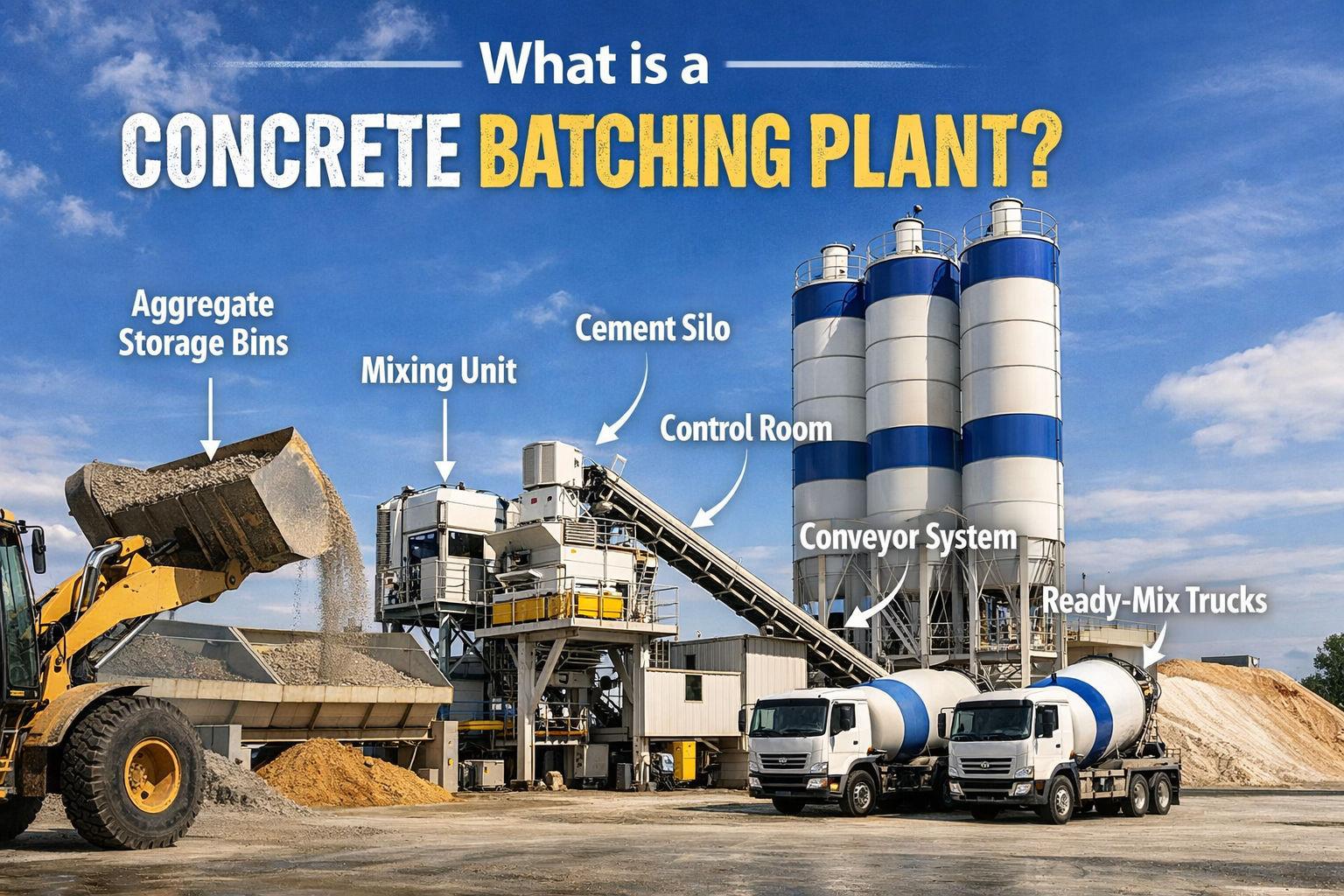
If you have ever stood on a construction site wondering where all that fresh concrete actually comes from, the answer is a concrete batching plant. And picking the right type can make or break your project timeline.
Whether you are managing a highway project, putting up a commercial building, or handling a residential development, understanding the different types of concrete batching plant helps you make smarter decisions about cost, speed, and quality.
This guide covers everything: what a concrete batching plant is, how it works, all major plant types, their components, how to choose the right one, and whether buying or renting makes more sense for your situation.
What Is a Concrete Batching Plant?
A concrete batching plant, also called a concrete batch plant or concrete mixing plant, is a facility that combines raw materials like cement, water, sand, gravel, and chemical additives in precise proportions to produce fresh concrete.
Think of it as a giant recipe machine. You feed in the ingredients in the right amounts, and out comes consistent, high-quality concrete ready for delivery or use on site.
Batching plants range from small portable setups you can move between job sites to massive stationary facilities that feed entire regions. The core idea is always the same: automate the mixing process to reduce human error, save labour, and maintain concrete quality across every single batch.
Modern plants are controlled by PLC (Programmable Logic Controller) or computer-based systems that handle everything from weighing materials to tracking production cycles.
How Does a Concrete Batching Plant Work?
The process is straightforward once you break it down step by step.
1. Material Storage: Cement is stored in airtight silos to keep it dry. Aggregates like sand and gravel sit in open bins or hoppers. Water is held in tanks, and chemical admixtures are kept in separate containers.
2. Weighing and Proportioning: Each material is measured precisely using load cells and weigh hoppers. The control system ensures the proportions match the mix design exactly, every single time.
3. Mixing: Materials move via conveyors or screw augers into the mixer, where they are blended into fresh concrete. In wet mix plants, water is added here. In dry mix plants, water is added during transport.
4. Loading and Dispatch: Mixed concrete is loaded into transit mixer trucks and delivered to the job site. Central mix plants fully blend the concrete before loading; transit mix plants finish mixing during the drive.
Advanced modern plants also use moisture probes in the aggregate bins to automatically compensate for natural moisture content, leading to even more accurate water-to-cement ratios.
Main Types of Concrete Batching Plant
There are more types than most people realize, and each one serves a specific purpose. Here is a clear breakdown of all the major types of concrete batching plant you will come across in real-world construction.
Stationary Concrete Batching Plant
Fixed in one location for the life of a project. Best for large, long-term jobs like highways, dams, and high-rise buildings. Offers the highest production capacity (up to 240 m3/h) and the most precise mix control.
Mobile Concrete Batching Plant
Mounted on wheels or a trailer for quick relocation between sites. Capacity typically runs 25 to 120 m3/h. Great for road construction, infrastructure repairs, and multi-site contractors.
Compact Concrete Batching Plant
A middle ground between mobile and stationary. Small footprint, modular design, and easy transport, but it can still produce significant volumes. Ideal for urban projects with tight space constraints.
Dry Mix (Transit Mix) Batching Plant
All ingredients are measured and loaded dry into the mixer truck. Water is added during transport. Popular with producers running multiple sites because it simplifies plant operations and speeds up truck turnaround.
Wet Mix (Central Mix) Batching Plant
All materials including water are fully blended at the plant before the truck leaves. Produces the most uniform, high-quality concrete. The go-to for precast operations, paving crews, and high-spec structural projects.
Portable Concrete Batching Plant
Similar to mobile but emphasizes quick assembly and disassembly. Excellent for emergency repairs, disaster relief, and remote rural projects far from urban ready-mix suppliers.
Fully Automatic Batching Plant
Computer-controlled from start to finish. Minimal manual labor needed. Consistent output every batch, with full data logging for quality assurance. Suits any project size where precision and low headcount matter.
Continuous Batching Plant
Runs without pause, feeding a steady stream of concrete rather than discrete batches. Essential for mega-projects like airports and major dam construction where interruption is simply not an option.
Batch Type (Batch Process) Plant
Produces one batch at a time with precise control over each mix. Preferred for specialized or custom concrete mixes. A solid choice for medium-scale projects and those with varying requirements.
Ready Mix Concrete Batching Plant
Pre-mixes all dry components before loading, then adds water during transport. Reduces cement consumption by 10 to 12 percent. Widely used for mass production of high-quality concrete for commercial and industrial builds.
Precast Concrete Batching Plant
Designed specifically for precast operations where concrete is poured into molds offsite, cured in controlled conditions, then transported as finished components. Delivers tighter tolerances and better repeatability than site mixing.
On-Site Concrete Batching Plant
Set up directly at the construction site, eliminating the need for third-party ready-mix suppliers. Compact, quick to install, and fully automated. Gives contractors complete control over concrete production and scheduling.
Dry Mix vs. Wet Mix: Which One Should You Use?
This is one of the most common questions contractors ask, and the honest answer depends on what your project actually needs.
| Factor | Dry Mix (Transit Mix) | Wet Mix (Central Mix) |
|---|---|---|
| Where water added | In transit truck during delivery | At the plant before loading |
| Concrete quality | Good, flexible water control on site | Excellent, highly uniform mix |
| Best for | Multiple job sites, longer hauls | Precast, paving, high-spec structural |
| Equipment complexity | Simpler, fewer moving parts | More complex, twin-shaft or planetary mixer |
| Truck turnaround | Faster | Slightly slower |
| Specialty admixtures | Harder to control precisely | Easier to dose accurately |
A practical tip: if you are doing both flatwork and precast on the same yard, consider a hybrid setup that supports both central mix and transit mix lines to match daily demand.
Stationary vs. Portable Batch Plants
Stationary Batch Plants
Stationary plants are fixed installations built for the long haul. They feature large aggregate bins, multiple cement silos, robust conveyor systems, and high-capacity mixers. Production rates can reach 240 cubic meters per hour or more.
These plants are ideal as regional concrete hubs that supply multiple job sites from a central location. The upfront investment is higher, but economies of scale make them extremely cost-effective when volumes are consistently large.
Portable Batch Plants
Portable plants prioritize mobility above all else. They need minimal foundation work, assemble quickly, and can be relocated as project phases shift. Production capacity is lower than stationary plants, but for contractors working in rural areas or on projects far from existing ready-mix facilities, a portable plant is often the only practical option.
Look for self-erecting mobile models that can set themselves up without a crane, cutting setup time significantly. When running remote operations, pair your portable plant with on-site water storage, admixture tanks, and a reliable power source to avoid supply disruptions.
Key Components of a Concrete Batching Plant
Every concrete batching plant, regardless of type, is built around the same core components. Understanding these helps you evaluate equipment quality and maintenance requirements before you commit to buying or renting.
• Storage containers that hold sand, gravel, and crushed stone separately until needed. Bin size directly affects how often they need to be refilled. Aggregate Bins:
• Sealed vertical storage tanks that keep cement completely dry. Most plants have at least two silos so different cement grades can be stored simultaneously. Cement Silos:
• The precision heart of any plant. These devices measure every material to the kilogram, ensuring your mix design is followed accurately batch after batch. Weigh Hoppers and Load Cells:
• Belt conveyors move aggregates from bins to the mixer. Screw conveyors (augers) transfer powdered cement from silos to the weigh hopper without spillage. Conveyors and Screw Augers:
• The machine that actually combines everything. Types include twin-shaft mixers (fastest and most thorough), planetary mixers (excellent for stiff mixes), and drum mixers. Mixer:
• Precisely controls how much water enters each batch, often with temperature compensation for hot and cold weather conditions. Water Metering System:
• Measure and inject chemical additives (plasticizers, accelerators, retarders) at the right point in the mixing cycle. Admixture Dispensers:
• The brain of the plant. Handles automated batching, batch ticketing, quality logging, and remote diagnostics. Modern systems also allow real-time aggregate moisture compensation. Control System (PLC or Computer):
• Captures cement dust at silos and transfer points. Essential for air quality compliance and keeping your yard safe and clean. Dust Collector:
• Maintain target concrete temperatures during extreme weather, critical for proper curing and final strength. Heaters and Chillers:
Advantages of Using a Concrete Batching Plant
If you are still relying entirely on third-party ready-mix deliveries, here is why a batching plant is worth considering for your operation.
• Every batch meets the same standard because proportions are computer-controlled. No more variation from one delivery to the next. Consistency:
• Producing concrete in-house is cheaper per cubic meter than buying ready-mix, especially at high volumes. Cost Savings:
• You are not waiting for a third-party supplier. Pour when you are ready, not when a truck happens to be available. Schedule Control:
• You control the mix design, water-to-cement ratio, and admixture dosing. Tight quality control is much easier on your own plant. Quality Control:
• Placing production closer to the job site cuts the distance trucks travel, reducing fuel use and emissions. Fewer Truck Emissions:
• Easily switch between mix designs for different pours: foundations, slabs, columns, precast. One plant, multiple mixes. Customization:
• Modern plants include dust collection, wastewater recycling, and aggregate washout recovery systems. Environmental Compliance:
Real ROI Example: Producing 17,000 cubic yards of concrete in-house versus buying ready-mix can save around Rs 7,75,00,000 over the life of a project. The break-even point typically arrives at just 6,000 cubic yards of production, after which every additional cubic meter adds directly to your margin.
Should You Buy or Rent a Concrete Batching Plant?
Not every project justifies buying a plant outright, and the rental market for used batching plants has grown significantly. Here is how to think about it.
When Renting a Used Batching Plant Makes Sense
Renting is often the smarter play for short-term projects, one-off contracts, or situations where you want to test the economics of on-site production before committing capital. Key advantages include:
• No large capital outlay, freeing cash for other project needs. Lower upfront cost:
• Used rental plants can often be on site faster than a new machine delivery. Immediate availability:
• A used plant has an operational track record. You can check its maintenance history rather than relying on spec sheets. Proven performance:
• Many rental agreements include servicing, so repair costs do not land on your plate. Reduced maintenance burden:
When Buying Makes Better Financial Sense
If you are producing concrete at high volumes regularly, ownership pays off fast. Once you pass the break-even volume threshold (typically around 6,000 cubic yards), every additional cubic meter of concrete produced in-house goes straight to your margin. For long-term or repeat contracts, ownership also gives you complete scheduling independence.
How to Choose the Right Type of Concrete Batching Plant
There is no single best plant. The right choice depends on your specific situation. Here is the decision framework most experienced contractors use.
• Large, long-running projects favor stationary plants. Short-term or multi-location work suits mobile or portable units. Project size and duration:
• Match plant capacity (m3/h) to your peak daily pour requirements, with some buffer for equipment downtime. Required production volume:
• High-spec structural or precast work needs a central mix (wet mix) plant. General commercial and residential pours can work well with transit mix. Concrete quality requirements:
• Limited space points you toward compact or mobile plants. Roomy, permanent sites can accommodate a full stationary setup. Site space and access:
• Remote sites far from ready-mix suppliers benefit most from on-site or portable plants. Location and logistics:
• Consider total cost of ownership including maintenance, consumables, and operator wages against the cost of buying ready-mix. Budget (CapEx vs. OpEx):
• Check local rules on dust emissions, noise, and wastewater disposal before specifying equipment. Environmental regulations:
• If you expect your volume to grow, choose a platform that can be expanded with additional silos or aggregate bins. Future scalability:
What's Next for Concrete Batching Plant Technology?
The industry is changing fast, and the plants coming to market in the next few years are a big step up from what most contractors are used to.
Real-time moisture probes are becoming standard, automatically adjusting water content for every batch based on the actual moisture in aggregates. This eliminates one of the biggest sources of mix variation and slump inconsistency.
AI-assisted mix optimization is emerging as a genuine competitive advantage. Systems can now analyze mix performance data and recommend adjustments to reduce cement content while maintaining target strength, cutting material costs without compromising quality.
Automated washout and water recovery systems are also gaining traction, allowing plants to reclaim aggregates from drum washout water and recycle it back into the process. This reduces waste, cuts water consumption, and helps plants meet tightening environmental standards.
For contractors investing in new equipment now, choosing a plant with a modern, open-architecture control system sets you up to integrate these technologies as they mature.
FREQUENTLY ASKED QUESTIONS
Common Questions About Concrete Batching Plants
Q: What is the difference between a dry mix and wet mix concrete batching plant?
A: In a dry mix plant, all ingredients except water are measured and loaded dry into the transit mixer truck. Water is then added during transportation to the site, giving operators flexibility to adjust slump on arrival. In a wet mix plant, all components including water are fully blended at the plant before loading. Wet mix produces more uniform, higher-quality concrete and is preferred for precast, paving, and high-specification structural work.
Q: What are the main parts of a concrete batching plant?
A: The core components are aggregate bins (for storing sand and gravel), cement silos (for dry powder storage), weigh hoppers and load cells (for precise measurement), belt conveyors and screw augers (for material transfer), a mixer (the main blending unit), a water metering system, admixture dispensers, a PLC or computer control system, a dust collector, and in some climates, heaters and chillers to control concrete temperature.
Q: What is the capacity range of a concrete batching plant?
A: Capacity varies widely depending on plant type and configuration. Small compact or mobile plants typically produce 25 to 50 cubic meters per hour. Medium plants range from 60 to 120 m3/h. Large stationary plants can reach 180 to 240 m3/h or more. When choosing a plant, aim for a capacity that covers your peak daily pour volume with some buffer for downtime.
Q: How much does a concrete batching plant cost?
A: Prices vary significantly based on type and capacity. Small mobile plants start from around Rs 23,00,000 to Rs 56,00,000. Medium stationary plants typically range from Rs 65,00,000 to Rs 1,40,00,00 Large high-capacity stationary plants can exceed Rs 2,34,00,00 to Rs 3,75,00,000 or more for fully equipped setups. Rental of used plants is available at a fraction of the purchase price and is a practical option for shorter projects.
Q: What factors should I consider when choosing a concrete batching plant?
A: Key factors include your required production volume (m3/h), project duration, site space and access, concrete quality specifications, budget for capital vs. operating expenditure, local environmental regulations, and whether you need a fixed or mobile setup. For large, long-term projects, a stationary plant delivers the best economies of scale. For shorter or multi-location contracts, mobile or portable plants offer the flexibility you need.
Q: Is it better to rent or buy a concrete batching plant?
A: It depends on your volume and project horizon. Renting a used plant makes sense for short-term projects, first-time in-house producers, or situations where you want to test the economics before committing capital. Buying makes financial sense when you are producing high volumes consistently. The break-even point versus buying ready-mix concrete typically arrives around 6,000 cubic yards of production, after which every additional cubic meter adds to your margin.